• Skip to main content
  • Skip to footer

William L. Stuart

author of The Gemstone Chronicles Series

  • Home
  • Blog
  • About
  • Contact

Gemstone Posts

Sodalite!! Can You Talk to Animals????

June 2, 2014 by Bill Stuart 2 Comments

Do you remember Dr. Doolittle? The guy who could talk to the animals? While not the same as the good doctor, in The Gemstone Chronicles books, Maggie is able to communicate with different animals using the magical powers of the sodalite!

Sodalite:

What is sodalite? From a mineralogical viewpoint, according to our friends over at Wikipedia, sodalite is a royal blue rock widely enjoyed as a gemstone. The stone has characteristic white streaks in it and its poor cleavage planes can show up as cracks in the surface. Originally discovered in Greenland, a vast deposit found in Canada made it accessible for ornamental purposes.

What does sodalite look like? Below is a picture of the rough (stone in its natural form).

Sodalite Rough

You can see the gorgeous blue color of the stone with the white streaks.

Use polished stones in a number of ways. Cabochons are common, as are beads. I included a picture of some sodalite beads.

Sodalite beads

Translucent sodalite, when faceted makes a beautiful jewel!

Faceted Sodalite

I know you must be wondering how these beautiful rocks allow someone to talk to animals. While researching the gemstones I would use in the books, I came across the idea that sodalite is a communication stone – and one that fosters calmness, serenity, and helps unify efforts. It is also considered a truth stone, much like the lapis lazuli. Since Maggie had to communicate first with the white stag, and then with a unicorn, it seemed a great stone to use.

I have found sodalites on some of our rock hunting trips. I tumbled some and they are gorgeous! One of them is my lovely and adorable bride’s favorite of all my tumbled stones.

If you want to know how Maggie used the sodalite and talked to the white stag and the unicorn, check out Book Two: The Amethyst or Book Three: The Emerald. When you do, leave me a comment or leave a review at Amazon, Goodreads, Barnes & Noble, or Smashwords!

Connect with me:

Find me on Twitter, Facebook, and Goodreads. I love to meet new friends!
Filed Under: Gemstone Posts

MOONSTONE – AND I’M INVISIBLE!?!?!?!

May 19, 2014 by Bill Stuart 1 Comment

In The Gemstone Chronicles Book Two: The Amethyst, Aidan and Maggie’s mother, Laura joins them for the return to Celahir. Keeper presents Laura with a gift of moonstone – the ancient birthstone for June. Among moonstone’s many magical properties is one that Laura and her friends and family found lifesaving – invisibility!!

What is Moonstone?

Before we talk about the invisibility, let’s explore what moonstone is. According to our oft-cited friends at Wikipedia, there are two varieties. The first and most common is the adularia. The second type is a feldspar with a pearly and opalescent luster.

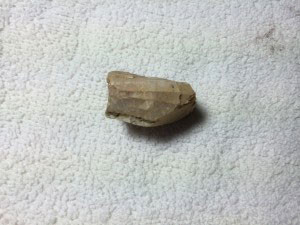
Because two feldspar species compose moonstone, the stone forms in layers. This makes the stone a great candidate for cabochons and for tumbling. Below is a picture of moonstone rough that I found during one of my many trips to Gold ‘n Gems Grubbin’. You can clearly see the layers of the stone.

Moonstone rough

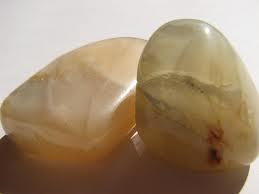
Here is a great picture of tumbled stone. Again, you can clearly see the layers within the stones.

Tumbled moonstone

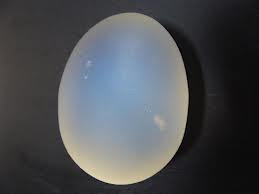
Moonstone also makes gorgeous jewelry! I added a couple of pictures of cabochons. the first is from Africa and has an amazing color.

African Moonstone

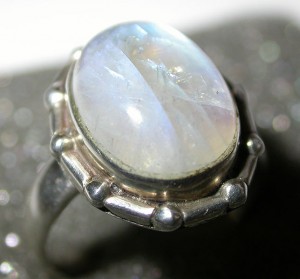
The last photo is of a cabochon ring. I think it’s beautiful!

Moonstone ring

I know you must be wondering where the invisibility comes into the picture. Moonstone has many properties associated with it. The Romans believed that the stone was made from solidified rays of the moon. The stone was believed to keep travelers safe, provide protection to swimmers, and make the wearer invisible!

Invisibility?

In The Amethyst, thugs attack Laura and our intrepid group of adventurers on a pier. As the attack commenced, Laura wished for her group to just disappear – and they did! She drew upon the power of the moonstone and poof – invisibility! This turned the tide of the battle and they escaped to face Brendon the Giant!

Moonstone played a small but crucial part in The Gemstone Chronicles! Beautiful, lustrous, and full of legendary magical properties, it’s a favorite stone of mine and one that will be in tumbler soon. And who know, maybe I can turn invisible, too!

Do you think that gemstones have magical properties? Do you use moonstone for protection while traveling? What about other gemstones? Leave me a comment and let me know!

Connect with me:

Connect with me on social media, too! Find me on Twitter, Facebook, and Goodreads. You can also email me at bill@williamlstuart.com or subscribe to the blog!

Filed Under: Gemstone Posts

The Diamond – Power Stone of The Gemstone Chronicles

May 6, 2014 by Bill Stuart 1 Comment

Diamonds!

When you think of diamonds, what is your first thought? Beautiful, sparkling, stones set in wedding rings? Glittering crown jewels from around the world? The Hope Diamond? A massive stone that channels power from other gemstones to maintain the balance between good and evil and the powers the barrier between Celahir and the human world? I think of the last (after the one in Lana’s wedding ring)!! Yes, I think of The Diamond – the Power Stone of The Gemstone Chronicles!!

In the books, The Diamond is a very large flawless stone. In reality, diamonds are not usually large like the one I envisioned for the power stone, but there certainly have been some huge stones found. The largest faceted diamond (545.67 carats) is called The Golden Jubilee, which was presented to the King of Thailand for his Golden Jubilee – the 50th anniversary of his coronation! See how beautiful it is!

Golden Jubilee Diamond

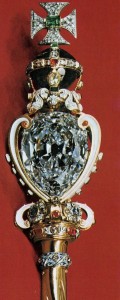
Wikipedia tells us that the largest gem quality stone ever found is the Cullinan Diamond. The Cullinan stone weighed in at a whopping 3106.75 carats (1.37 pounds!). It was cut into 9 major stones (and 96 smaller stones), the largest of which is Cullinan I or The Star of Africa. Cullinan I was the largest faceted diamond until the discovery of the Golden Jubilee. Weighing in at a hefty 530.4 carats, it is part of the Crown Jewels of the United Kingdom. Below is a picture of this incredible stone set in the Sceptre with the Cross!!

Cullinan 1 Diamond

The Diamond in The Gemstone Chronicles:

In Book Four: The Ruby, The Spider Queen has delved deep into the bowels of Celahir and found a black twin of The Diamond that controls the barrier. As I researched diamonds for this post, I found that one of the largest faceted stones is a black diamond! The Spirit of de Grisogono, weighing in at 312.24 carats,is a beautiful stone. Unfortunately, I couldn’t find any pictures that I could use here, but do a quick search for it. Its beauty is stunning!

One of the things I want to do soon is visit Crater of Diamonds State Park in Arkansas. As you might have seen on the news recently, a visitor found a 6.19 carat stone. Since I love to hunt for gemstones, this sounds like an ideal weekend trip for me! I am mentally planning the road trip even as I work on this post.

The reason I chose diamond to be the power stone of The Gemstone Chronicles is due to its reputation as the strongest and most powerful of gemstones. The Ancient Greeks called it “adamas” meaning invincible or indestructible. Those properties made it the ideal stone to channel the powers from the Elven Bow and the Elven Sword!

What is your favorite diamond? The Hope Diamond? One of the stones mentioned in the article? Or maybe, the diamond in your wedding ring?? Leave me a comment and let me know!

Filed Under: Gemstone Posts

Lapis Lazuli – Beautiful Blue Gemstone

April 26, 2014 by Bill Stuart 6 Comments

Lapis Lazuli!

One of the most beautiful semi-precious stones I discovered while writing The Gemstone Chronicles is the lapis lazuli – a beautiful blue gemstone!! I haven’t found one, but I’d certainly like to!!

One of the interesting characteristics of the lapis lazuli is the golden flecks that are found within the structure of the stone. According to Wikipedia, the stone has been mined since at least the 7th century BC! It has long been highly prized due to its intense deep blue color. The main mineral is lazurite and the golden flecks are pyrite. Below is a picture of the gemstone rough.

Lapis Rough

Wikipedia also tells us that lapis was used in the eyebrows of King Tutankhamen’s death mask!

In The Gemstone Chronicles Book One: The Carnelian, I used the lapis lazuli as a stone to detect truth. In the book, Alatariel, one of the Elven Scouts, tried to determine if Beebop and Nana were enemies of Celahir by using the stone. For whatever reason, both surpassed the stone’s ability to detect their intentions. But, it isn’t a stretch from one of its most commonly believed attributes. Truth and wisdom are two of the lapis lazuli’s characteristics. Perhaps that is why the stone decorated many priestly garments in ancient times.

Other uses:

The stone, once it is ground into a fine powder, is used to create the color ultramarine, an intensely blue color that artists the world over have used – including Michelangelo!

Jewelry from lapis is gorgeous! Below are a few pictures of lapis lazuli stones. The first is a lapis cabochon.

Lapis lazuli cabochon

I couldn’t resist adding a picture of a of an Egyptian style necklace!

Lapis lazuli necklace

I was glad to come across the lapis lazuli gemstone! Brilliantly blue and a stone of truth and wisdom, it played its part extremely well in Book One: The Carnelian!

What unique gemstones do you have in your collection? Do you have a lapis? If so, share a picture with me or just leave me a comment and let me know what you think! If you have read any of The Gemstone Chronicles books, leave me a comment, too, or, even better, write a review! I love to know what you think!!

Filed Under: Gemstone Posts

Bloodstone – The Great Healing Stone!!

April 15, 2014 by Bill Stuart 2 Comments

In the middle grades/young adult fantasy adventure series The Gemstone Chronicles, one of the most important stones is the bloodstone. The stone isn’t one of the gemstones from the Elven Bow or the Elven Sword, but it gets used often. Why, you might ask? Well, the bloodstone is a healing stone and, as readers know, the heroes of the stories need a lot of healing!!

What is a bloodstone?

What is a bloodstone? According to Wikipedia, heliotrope is the more common name for the stone. Bloodstone is a form of chalcedony (which is a form of quartz). The most common version is green with red inclusions of iron oxide or red jasper. A stone with yellow inclusions is called plasma. Below is the “classic” bloodstone with the red inclusions.

Bloodstone

Throughout history, many believed bloodstones had magical properties. Chief among those beliefs was the ability to heal a bleeding wound simply by touching the injury. In The Gemstone Chronicles, Nana learned to use the gemstone from the elf Alatariel. She healed Beebop’s ankle when Aidan injured him while playing with levitation. Beebop was also able to use the stone quite well as the bloodstone (along with the aquamarine) is the traditional March birthstone. in the books, simply touching the injury didn’t heal it, but they had to draw power from the stone to use it. Although it wasn’t part of the books, another very common belief is that the bloodstone could defeat enemies magically.

I discovered that bloodstone is also known the “Martyr’s Stone.” Legend says that drops of Jesus’ blood fell during the crucifixion. The blood stained jasper at the foot of the cross, and imbued it with magical powers. Many scenes of martyrdom were carved from the stone because of that legend.

I loved using the bloodstone in the books. A beautiful, glossy, and magical stone, it ranks right up there as one of my favorite gems. It can be awesome as a faceted stone, a cabochon, and a tumbled gem. Now, if I can just find one…

Do you have bloodstone jewelry? If so, leave me a comment and let me know about it. If not, what are you waiting for?

Connect with me:

If you use social media, find me on Twitter, Facebook, or Goodreads and let’s connect. I enjoy meeting new friends! We can discuss, book, reviews, bloodstones, or just about anything else!

Filed Under: Gemstone Posts

Hematite – Gray, Silver, or Red?

April 7, 2014 by Bill Stuart 1 Comment

Hematite!

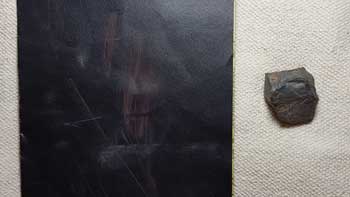
Hematite is an enigma to me. When you find the stone in its natural form, it’s a dark gray color and can have lots of sharp edges. When you polish it, it turns a lustrous silver color, but, if you rub it across dark sandpaper, it leaves a red streak behind. See what I mean about an enigma? Below the one of my hematite pieces in its raw form.

Hematite rough

What exactly is hematite? Our friends over at Wikipedia say that it is an iron(III) oxide (Fe2O3). The colors vary from black to silver-gray to brown to reddish-brown, to red. Hematite is from the Greek word for blood and has been used as a pigment for centuries. Enough of the dry mineralogical stuff. Now to the cool stuff that was found in The Gemstone Chronicles books!

When I was researching gemstones to be used as stones in the books, I wanted to find unusual mystical or magical properties associated with the various rocks. I hit upon hematite as a stone used by Native Americans to make war paint. The warriors believed the war paint made from the stone made them invincible in battle. In Book Three: The Emerald, our heroes add hematite to their gemstone collection to help them in battle. They also stop the dwarves from mining the mineral for Naesse’s army so that the Drow wouldn’t have the same battle advantage.

Other magical and mystical properties include scrying in the reflective polished surface, curing blood disorders, and protecting the wearer from negativity or others.

As I mentioned above, the polished stone becomes a very lustrous silvery color and has an almost mirror-like quality. See how the lights reflects off the polished surface?

Tumbled hematite

The Red Streak:

Finally, I have a picture of the rough stone and some black sandpaper. I rubbed the stone across the sandpaper and left the red streaks behind. The Egyptians called it a bloodstone since the water used to clean the stone would turn red like blood. As you can see from the sandpaper, it wasn’t such a stretch!

Hematite red streak on sandpaper

If you want to be invincible in battle (maybe), or just want a cool looking silvery stone, find yourself some polished hematite! And, if you happen to see some dwarves digging for it, STOP THEM! We can’t have the Dark Elves becoming unstoppable!!

What are your thoughts on hematite? Do you think it is as cool as I do? Leave me a comment and let me know!

Filed Under: Gemstone Posts

  • « Go to Previous Page
  • Page 1
  • Page 2
  • Page 3
  • Page 4
  • Page 5
  • Page 6
  • Page 7
  • Go to Next Page »

Footer

Follow Me on Social Media

  • Email
  • Facebook
  • Pinterest
  • Twitter

Follow Me on Goodreads!

Follow Me on Goodreads

Search this website

Site Policies

  • Privacy Policy
  • Terms of Use
  • Cookies Policy
  • Accessibility Statement

Copyright © 2026 Food and Fiction, LLC. All rights reserved.