• Skip to main content
  • Skip to footer

William L. Stuart

author of The Gemstone Chronicles Series

  • Home
  • Blog
  • About
  • Contact

Gemstone Posts

Tiger’s Eye Cabochons

January 18, 2022 by Bill Stuart Leave a Comment

I haven’t done a gemstone post in quite a while. For those who regularly read the blog (and thank you for visiting), you know that I used gemstones in The Gemstones Chronicles series and how I enjoy searching for and polishing rocks. For those who are new to the blog, welcome and I hope you find interesting things and become a regular visitor. Now, back to the gemstones. As I showed in my posts about my rock polishing workbench, I have the equipment necessary to make cabochons from the rocks I find (and I have a lot of rocks). Though I have templates to make various sizes and shapes of cabochons, I like to work with the natural shapes, too. This post will have one of each. Check out my Tiger’s Eye Cabochons!

Template Tiger’s Eye Cabochon:

The stone below is an example of a cab I made from a piece of tiger’s eye using a template. It’s a large stone, as shown in the first picture, weighing in at 140 carats and 2 inches x 1.5 inches before I cabbed it and 69 carats and 1 5/8 inches x 1 3/8 inches after cabbing. I think it would make an awesome pendant. I might try my hand at wire-wrapping it (though my previous attempts at wire-wrapping weren’t exactly spectacular), Still, if at first you don’t succeed….

Tiger's Eye Cabochon Slab
Tiger's Eye Cabochon Large

Natural Shaped Tiger’s Eye Cabochon:

The second stone I want to highlight today is another tiger’s eye. This time, though, I went with the natural stone shape rather than use a template for the shape. I don’t have the weight and dimensions prior to cabbing it, but it finished at 22.8 carats and 1 inch x 3/4 inches on the longest side. As with the first stone, this one could end up in a pendant. If I had the skills, I’d do a bit of silversmithing and create a custom setting for it, but, alas, I haven’t taken any classes on that yet, nor do I have the materials necessary. I do know how to solder, though, so maybe…

Tiger's Eye Cabochon Small

What do you think? Which cab do you like better? Leave me a comment and let me know!

Connect with me:

Find me on Twitter, Facebook, Goodreads, and Pinterest. Let’s talk books, gemstones, and polishing rocks!

Filed Under: Gemstone Posts

Rock Polishing Hobby Bench Part 3 – The Final Product

August 30, 2021 by Bill Stuart Leave a Comment

If you’ve been following along, I’m at the end of my rock polishing hobby bench series of posts. The first post was the wall I built, the second was my industrial/steampunk inspired light (made of pipe), and now, the final product, the workbench itself. In keeping with the industrial look, I used pipe to build the base, 2X6 lumber for the top, and mounted all my toys for polishing rocks and gemstones.

The bench base:

Let’s start with the base. I used 3/4” pipes and pipe nipples to create a sturdy foundation for the top (important because I don’t want it to collapse). The entire base is just under ten feet long and about twenty-four inches wide. I built it to accommodate a barstool height chair and it works perfectly. Just the right height to work the stones.

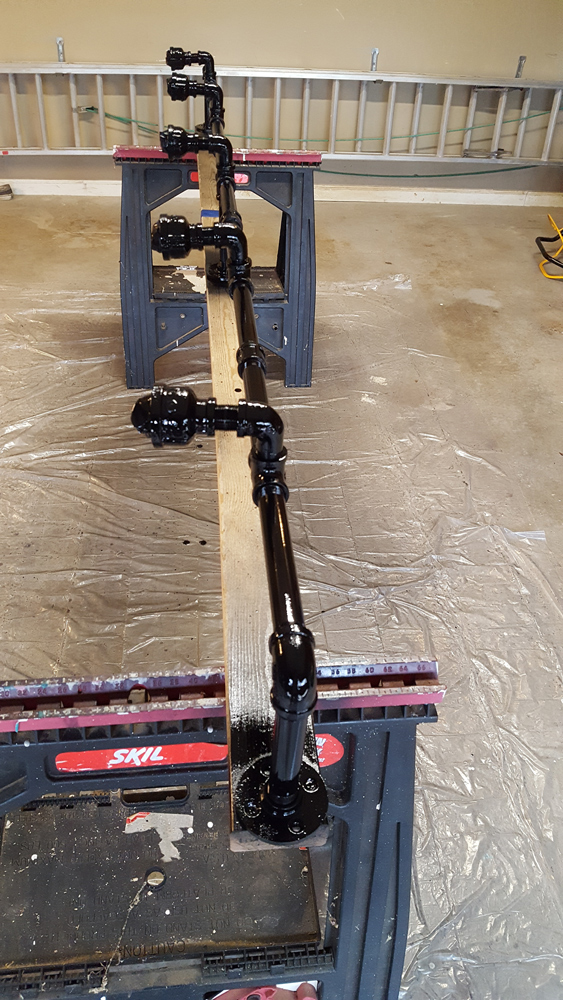
Here is the base after I painted it black to match the light (got to be coordinated, you know).

Pipe base

The bench top:

The top, as I mentioned above, is made of 2X6 lumber. Nothing fancy, just off the shelf interior pine boards. I used my pocket hole jig to create screw holes to join the boards together (makes it sturdier, I think). I sanded it lightly, mostly to remove the markings from the boards, then put it on the floor, top side down so I could attach the base. Below is the assembled top.

Bench top

I attached the base using 1 5/8” drywall screws through the flanges I installed on the top of each nipple. Nice and secure. Then, I asked John, my rock hunting companion and brother, to help me move it into the basement (which meant taking it across the lawn and through the basement door, rather than trying to take it down the stairs inside). Once we got it there, we centered it on the wall and that was that!

The equipment:

I cut a hole in the top for my Highland Park cabochon drive belt to pass through and reach the motor that I mounted below the bench. I built a small belt guard to keep things from getting caught up in the belt (safety first), and drilled a few holes for water and drain lines. In addition, I mounted my Rock Rascal next to the HP equipment. Of course, I left room for faceting equipment (one day). I also added a variable speed bench grinder with a felt polishing wheel for final buffing of the stones.

At the very end of the bench, I left space on the wall for my homemade flat lap. Now all my toys are in one place, and it’s easy to move from one to another. I even added some anti-fatigue mats on the floor, just for comfort when I’m standing up on the hard concrete.

The final product:

Bench with rock polishing toys

There you have it! The final step of the project. I’ve used it a lot since I finished it and everything works just as I wanted it to. Overall, a fun project that wasn’t too difficult, and I’m sure it will keep me busy with the rocks I’ve collected.

What do you think? Any suggestions to improve it? Connect with me on Twitter, Facebook, Goodreads, or Pinterest and let me know! Happy rockhounding and rock polishing!

Filed Under: Gemstone Posts

Rock Polishing Hobby Bench Part 2 – The Light!

July 13, 2021 by Bill Stuart Leave a Comment

You recall my post about my rock polishing hobby workbench, where I built the wall I needed. Today’s post is about the light fixture I built to shine light on my projects. Read on for the details!

The building of the light fixture:

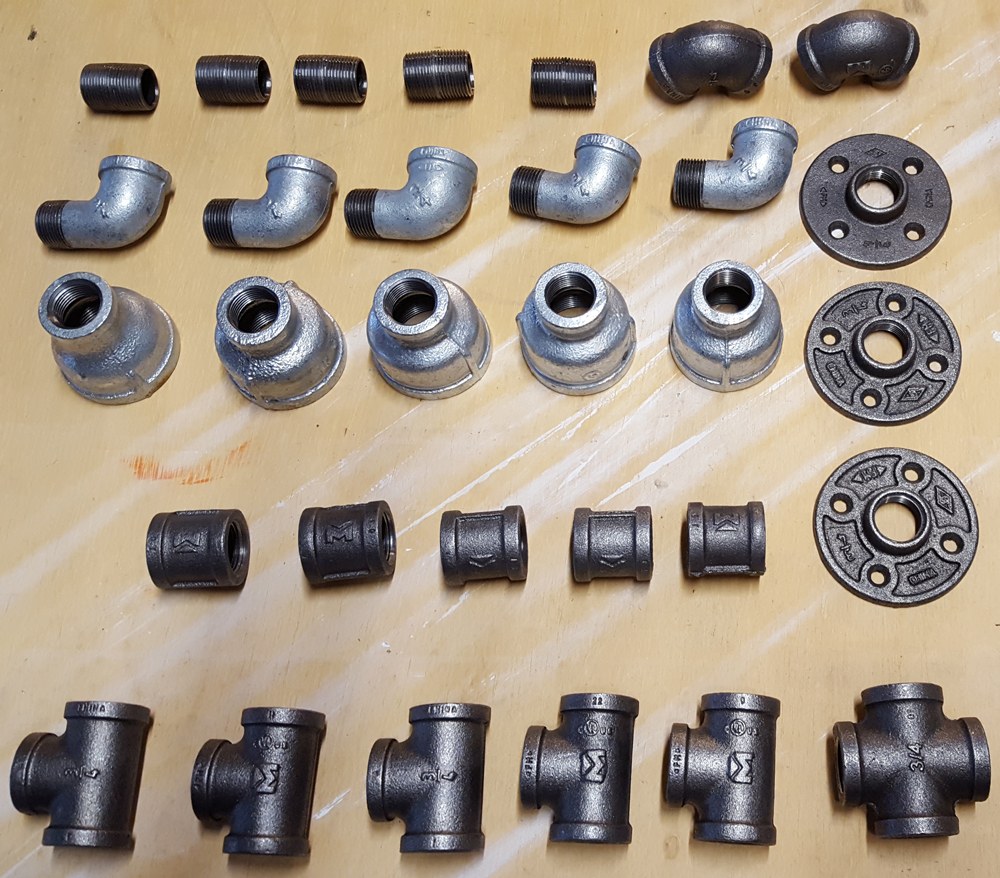
I like the look of some of the industrial fixtures I’ve seen, so I decided to make my light from metal piping and paint it black. Here are the fittings I started with:

Light fixture fittings

I had to work out the dimensions before I bought the piping, how the fixture would mount to the wall, and where the wires had to end to ensure I could get power to the lights. I also wanted to have the fixture wired to a switch to make it easy to turn on and off. All of that went into the design. I assembled it, wired each socket, and ran the wires for power.

After getting it assembled and the wires pulled, I wired it temporarily in my garage so I could test it. Guess what? It worked!

Light fixture electrical test

I mounted it to a 2X4 so I could paint it. It kept the fixture upright so I could get all sides of it painted. I also made sure to put tape over the sockets to keep paint out of them. I think it turned out nicely.

Painted Light Fixture

Installation:

Mounting it on the wall was a little awkward given the length of it, but I used a couple of 2X4s to hold it at approximately the height I wanted, then loosely screwed it into the studs on one end and in the middle. I ran the wires through the wall and then tightened everything and removed the 2X4 supports.

When I had the electricians wire the wall, I asked them to put a wire from the switch to a junction box for me to connect the fixture. I made sure I turned off the breaker (safety first!) before I wired it. I pulled the fixtures wires into the junction box and connected them to the power wire the electricians left me. Once I had it wired and the junction box cover installed, I closed the breaker and flipped the switch and there was light!

The finished product:

I added some Edison light bulbs in keeping with the steampunk-inspired industrial look, and left the air ducts, AC coolant lines, and joists exposed to add to the look. I like the way it turned out and it gives me 300 watts of light over the workbench. Seems like a lot, but since the workbench will be ten feet long, a lot of light is needed.

The finished light fixture mounted to the wall

What do you think? Connect with me on social media and let me know. I’m on Twitter, Facebook, Goodreads, and Pinterest. You can also email me at bill@williamlstuart.com.

Filed Under: Gemstone Posts

Rock Polishing Hobby Bench Part 1 – The Wall

June 7, 2021 by Bill Stuart Leave a Comment

As my readers know, I enjoy many different hobbies and interests. Writing my books, reading and reviewing other authors, submarines, gold prospecting, and, of course, rockhounding and hunting for gemstones are among them. As I’ve accumulated rocks, I need a place to work on them. If you’ve read the blog for any length of time, you’ll recall my post about my rock polishing toys. I decided to build a workbench in my basement to accommodate all of them, plus a little room for more toys. In order to do that, I started with the wall!

Before the Wall:

My basement is partially finished, so I decided to use a portion of the unfinished basement for my rock hobby area. Here is a picture of the unfinished wall I started with:

Unfinished Wall

Wall Construction:

I had to sheetrock the wall, which was a new skill for me. You can see from the picture above that I used a strip of wood to hold the upper sheets in place (since I was doing it myself) while I screwed it to the studs. Worked great!

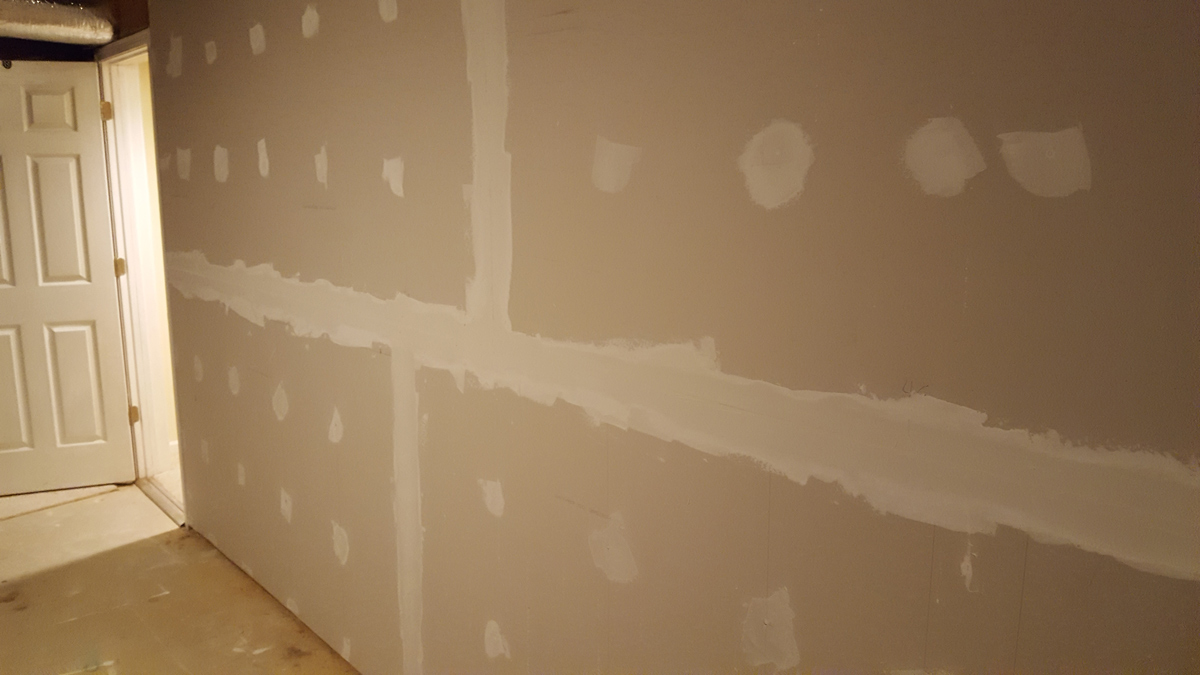
Getting the lower sheets done was a lot easier and before long, I was ready for tape and mud! I’m glad I did some research about staggering the joints.

Wall with Tape and Mud

Here is the finished wall! I decided to paint it white to reflect as much light as possible. Since I don’t have any windows on that side of the basement, natural light wasn’t an option.

Painted Wall

Electrical:

Of course, I had to have power for the equipment. I contracted that part out. I probably could have done it since I have a background (from many years ago) as an electronics tech and a maintenance electrician, but it has been too many years to be up to speed on the electrical code. I laid out where I wanted the outlets, though, and had them installed at four feet above the floor. That way I didn’t have to crawl under the workbench every time I had to plug in a toy. I also made sure I had plenty of outlets on a dedicated circuit. I even made sure to include the GFCI outlet since the toys require water and water and electricity don’t play well together. It pays to plan ahead!

Outlets

This was only the first step in the project. The next step will be the light fixture. I won’t give away much about it, but it gives me the light I wanted (plus it looks cool)! Stay tuned for it!

Connect with me:

Find me on Twitter, Facebook, Goodreads, or Pinterest and let’s connect!

Filed Under: Gemstone Posts

Gemstones and Fluorescence – Who Knew!?

March 16, 2020 by Bill Stuart 1 Comment

I learned something new recently (at least new for me). I accidentally discovered, through an unrelated web search, certain gemstones exhibit fluorescence under ultraviolet (UV) light. Now, this may not be news to some of you, but it surprised me!

Fluorescence:

What is fluorescence and why do some gemstones exhibit it and others don’t? According to an article by Hobart M. King, PhD, RPG on Geology.com, certain minerals can absorb a small amount of light and then emit a small amount of light in a different wavelength. This change in wavelength appears as a color change to the human eye. Here is a link to the article so you can see more for yourself!

Additional research taught me fluorite, rubies, some emeralds, and diamonds fluoresce. What do I have from my many rock hounding trips to the North Georgia Mountains? Rubies and emeralds (no diamonds, but I may be headed to Arkansas later this year to see if I can find a diamond or two, but that will be another post)! No fluorite that I know of, though. To test my rocks, I asked for a UV flashlight for Christmas and I was lucky enough to get one.

Checking my rock collection:

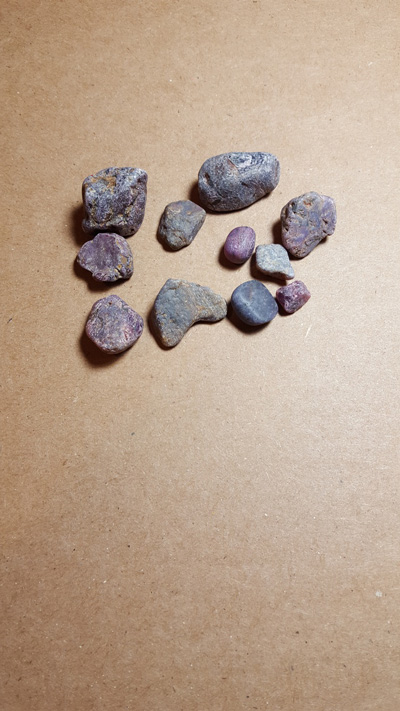
After the Christmas festivities were complete (including a delicious prime rib linked here), I spent time examining my rock collection for signs of fluorescent stones. Guess what? I found some! The rubies show up well (chromium, which gives rubies their red color, is an activator for fluorescence) and a few of my better emeralds have a slight reddish glow. Who knew? I wondered why the sapphires didn’t fluoresce and discovered that iron can dampen fluorescence, even though the titanium can acts as an activator. Both of those elements give sapphires their blue color. Here are a few pictures to illustrate the change with the UV light. The first two are rubies under regular light and then under the UV light. I love the pink color!

Rubies without fluorescence
Gemstones Under fluorescence

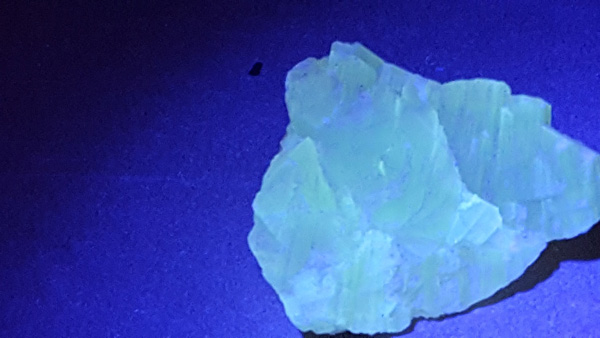
The next two pictures are of a yellow rock that I really don’t know what it is, but it glowed a lovely pale green under the UV light.

Fluorescence Yellow Rock
Yellow Rock under Fluorescence

I realize using a long wave UV flashlight like I received at Christmas will not show the fluorescence on all the stones that possess the property. For that, I’d need a shortwave UV lamp. I may have to order one to see what the difference between the two devices is. If I can get one that is portable, I can take it with me and use it during my rock hounding excursions.

Safety First:

If you decide to use a UV light, make sure to use it safely. UV light is the same light that causes sunburn, so don’t shine the light on your skin. Don’t look into the light directly and don’t shine it on another person or a pet. Wear UV protective glasses, too!

Did you know about gemstones and fluorescence? Leave me a comment and let me know. I’d love to see some of your pictures. As I find more fluorescent stones, I’ll try to post pictures.

Connect with me:

Find me on the socials and let’s connect. I’m on Twitter, Facebook, Goodreads, and Pinterest. Say hi and let’s talk about rocks (or books)!

Filed Under: Gemstone Posts

New Rock Polishing Toys – What Do You Think?

February 20, 2018 by Bill Stuart 1 Comment

New Rock Polishing Toys!!

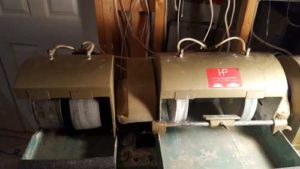
Gemstones fascinate me and are key elements in The Gemstone Chronicles fantasy adventure series I wrote. I’ve been looking for cabochon equipment for a while now and I lucked up upon a vintage Highland Park A-50 and a Rock Rascal Saw. The A-50 is mounted on a rolling cabinet and the saw is firmly installed on a nice little table. Check out the pictures below!

Rock Polishing Toys Highland Park A-50 Rock Polisher
Highland Park A-50
Rock Polishing Toys Rock Rascal Polishing Wheel and Slab Saw
Rock Rascal

The repairs:

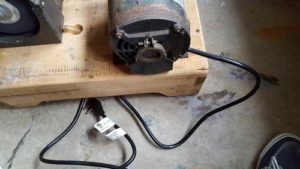
Given the equipment hadn’t operated in a while, I had a bit of work to do on the machine. First thing I did was to replace the power cord to the A-50 motor. Once I finished that little repair, the motor ran perfectly. I discovered the water pump bucket was rusted through, but that didn’t stop me. I cut a 5 gallon plastic bucket down to size and it fit like a glove inside the original bucket. The pump discharge fitting was cracked and the hose wouldn’t fit properly, so I engineered a fix and it works amazingly well!

The Rock Rascal, as you can see from the picture above, needed a new power cord, too. Luckily, I learned a bit about electrical and electronic stuff back in my Navy days, so, like the cord for the A-50, it was an easy fix. Doesn’t make me want to be an electrician again (like I was right after I left the Navy), but it’s satisfying to make it work. Once complete, I op tested it and everything ran smoothly.

Rock Polishing Toys Rock Rascal with new power cord

I think I might modify the A-50 to add more wheels, but that will be down the road. For now, I’ll pick up various grit belts to use on the expanding drums and use a 6 inch wheel I received for Christmas on the Rock Rascal. Now, I just need a water source and return for the wheel.

The equipment package included a new 6 inch diamond blade for the Rock Rascal, a dopping pot, dopping wax, and cabochon templates. I’m all set now (or will be as soon as the new belts come in)!

What do you think about my new rock polishing toys? Personally, I can’t wait to see if I can make a cab or two. Maybe I can do something with all the rocks I found during my gemstone hunting trips. I might even be able to polish a sapphire or ruby once I get diamond belts for the expanding drums.

Connect with me: 

Like my new toys? Have advice for a novice rock polisher? I appreciate any comments and emails with tips and hints. I’m on social media, too. Find me at Twitter, Facebook, Goodreads, and Pinterest, so don’t be shy! Say hello!

Filed Under: Gemstone Posts

  • Page 1
  • Page 2
  • Page 3
  • Interim pages omitted …
  • Page 7
  • Go to Next Page »

Footer

Follow Me on Social Media

  • Email
  • Facebook
  • Pinterest
  • Twitter

Follow Me on Goodreads!

Follow Me on Goodreads

Search this website

Site Policies

  • Privacy Policy
  • Terms of Use
  • Cookies Policy
  • Accessibility Statement

Copyright © 2026 Food and Fiction, LLC. All rights reserved.