• Skip to main content
  • Skip to footer

William L. Stuart

author of The Gemstone Chronicles Series

  • Home
  • Blog
  • About
  • Contact

Book Reviews, Thoughts, and Random Interesting Ideas

Reactor Shutdown – Recruiting Duty (My Navy Career Ends)

November 2, 2014 by Bill Stuart 11 Comments

In two previous posts, I chronicled my path from boot camp through Navy Nuclear Power School, and then from graduation from prototype to my time spent aboard USS Sandlance (SSN660). Today’s post will be the final installment of this series and will follow my path from Sandlance to recruiting duty and the end of my Navy career. This is my picture from my first day on recruiting duty at NRD Atlanta!

Recruiting Duty September 1989
Recruiting Duty NRD Atlanta

Recruiting Duty:

Why go to recruiting duty after spending 6 years going through nuclear power training and qualifying aboard a submarine? It was a little strange, I guess, but I had been aboard Sandlance from October 1985 – August 1989. In May 1988, Sandlance went into the shipyards in Portsmouth, NH, leaving Charleston, SC.

I married the lovely and adorable Lana in July 1988 and moved her and my daughter Laura to Dover, NH. We spent a year there, but it was time to move on to something else. Lana and I wanted to head back to the warmer world of the South, and recruiting duty seemed like a good fit. I requested the transfer and it was granted! Below is my recommendation from my CO.
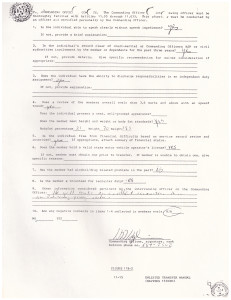
Recruiting Duty Recommendation

Recruiting School:

The first part of recruiting duty consisted off 5 weeks of training in Orlando. The coursework was not difficult – especially compared to the previous regimen I experienced in Orlando, but it was challenging in its own way. One of the more awkward training sequences was making cold calls. Anyone who has been in most any kind of sales knows about cold calling. Basically, you have a list of phone numbers and a script and you call someone at random and try to convince them to buy your product. Memorizing the script was pretty easy, but trying to stay on script with people who didn’t want to talk to you was difficult. It did help to develop a thick skin, which was a necessary trait for a recruiter, and one that I still use today in my role as a global supply chain manager.

The 5 weeks flew by and I graduated and was selected as “Most Likely To Succeed” by my classmates. I was surprised and humbled by the honor! Here is my award!

Recruiting Duty Most Likely to Succeed Certificate

NRS Americus, GA:

My duty station was Naval Recruiting District Atlanta and my office the Naval Recruiting Station Americus. For those who don’t know where Americus is, it is in South Georgia about 30 miles from Albany and about 10 miles from Plains, GA (home of former President Jimmy Carter). If you have ever gone down I 75 and turned at exit 101 in Cordele, you were at the eastern edge of my recruiting territory. The western edge was at the Alabama line in Stewart County. I had 9 high schools to visit monthly, so I logged a huge amount of windshield time!! One thing about recruiting duty is the awards you get. The recruiting world is very keen on recognition! I added a few pictures of awards I received further down in the post and pictures of my recruiting badge (rookie cookie and with gold star) and business card.
Recruiting Duty Rookie Cookie Badge
Recruiting Badge Rookie Cookie
Recruiting Duty Gold Wreath
Recruiting badge with 6 gold wreaths
Reccruiting Duty Business Card

Interestingly enough, recruiting duty helped me decide on my college major. Georgia Southwestern State University is located in Americus, and happened to be right on my way home. It seemed only natural to  go to school there and, given that recruiting is part of the Human Resources function in most places, HR Management became my major. That is probably about as diametrically opposite to nuclear power as one can get!

A day in the life:

What did I do while on recruiting duty? Besides logging the windshield time, I did my high school visits, and made the required cold calls. I filled out tons of paperwork and ran waivers on kids that needed them. Mostly, I tried to present an accurate picture of what the Navy was all about. I know the reputation that recruiters have for telling potential recruits whatever was necessary to get them to sign on the dotted line, but I didn’t do that (as every recruiter in the world will tell you). Seriously, I didn’t!

My recruits:

Over the three and a half years of recruiting duty, of all the people I sent to boot camp and only two of them didn’t make it through. One broke an ankle and the other caught pneumonia. Of all of the kids I recruited only three didn’t go to boot camp, so I had a pretty good track record. Below is one of my Delayed Entry Program (DEP) Management Awards.

Recruiting Duty DEP Mgt Award
DEP Management Award

For you submarine sailors out there, you know the cup, but we had a couple of cups, too!
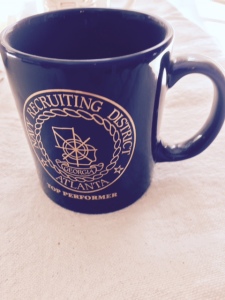
Recruiting Duty Cup 1

I have to recount one story, though. During a visit to one of my favorite high schools, I set up my table at lunch to talk to kids while they were in the cafeteria. Across from me was a Marine Gunny Sergeant, all decked out in his dress blues. I was wearing my normal winter blues, so I was definitely out dressed.

Anyway, this kid asked the gunny what all his ribbons meant and all was fine until the gunny pointed to his sea service ribbon (with 3 stars) and told the kid it was some kind of Marine Corps ribbon. I couldn’t take it and told the gunny to tell the kid the truth. The gunny gave me a cold stare, but the kid noticed that I had the ribbon, too (with no stars). He asked me what it was and I told him. The kid got mad because the Marine was lying to him. The Marine was mad at me because he thought he lost a recruit, and I just smiled! I think the kid eventually went into the Air Force.

My recruiting style:

That was the way I conducted my time as a recruiter. I would tell the kids that, based on their ASVAB scores, they qualified for certain jobs, although I couldn’t guarantee that job. I drove most of them to Atlanta, and waited while they went through physicals and job classification. Afterwards, I drove them home, encouraged them to tell their friends about me and the Navy, and monitored them until they departed for boot camp. Many of my recruits came back to work for me for a week after boot camp and enthusiastically spoke to former classmates and friends about their Navy experiences.

While on recruiting duty, I finished my degree (which the Navy mostly paid for), and was a walking poster child for getting an education while serving on active duty. Since school was on the way home, I often wore my uniform to class. That generated a lot of leads and conversations – especially when people found out that I served aboard submarines! I did nuclear power lectures for math and science classes. Once I had to speak extemporaneously for an hour during a school club day! Like I said, while not as academically challenging as nuke school, recruiting duty taught me a lot. I still use the presentation skills in my job today.

The end of my Navy career:

I wanted to go back to sea after recruiting duty and planned to go to King’s Bay, GA on a missile boat. However, when I called my detailer, he told me I could go to Bremerton, WA or Pearl Harbor, HI. I told him that he forgot option 3….see ya! I had recently graduated with my degree in HR. My wife was in graduate school and my daughter a junior in high school. Uprooting them was out of the question. August 23, 1993,  a little over 10 years from my date of enlistment, I left the Navy with an honorable discharge. I headed out into the civilian world, my Navy career at an end.

Post Navy:

I never worked in HR after I got my degree. I’ve spent most of my post-Navy career working in the human and animal pharmaceutical business in supply chain. I completed a master’s degree in Management and have had a great life. I’m happily married to my amazing wife, Lana. I have an amazing daughter, and two incredible grandchildren. I’ve written four books (The Gemstone Chronicles series). I’m starting my fifth book. I learned to hunt for gemstones, and prospect for gold. I generally enjoy my life!

What might have been:

I do occasionally wonder what would have happened had I stayed in the Navy. If I had, I probably would have applied for OCS, and who knows where that may have led? I miss the guys from the boat (not the boat so much), and stay connected with quite a few of them. All told, my Navy career was a formative time and it remains firmly entrenched in everything I do!

Did any of you readers spend time as a recruiter? If so, leave me a comment and let me know how your experience was. If you served in any branch of military, did your recruiter tell you the truth? Did you know what to expect when you enlisted? I’m always interested to hear stories about recruiting duty or tales of the wrong and right actions of recruiters.

Connect with me:

Feedback, follows, and shares are always welcome on the blog. Connect with me on social media. Find me on Twitter, and Facebook. I look forward to meeting new friends and reconnecting with old friends! And, if you don’t want to miss a post, subscribe to the blog!

Filed Under: Cool Things

Calhoun Mine – One of Georgia’s Richest Gold Mines

October 27, 2014 by Bill Stuart 19 Comments

In a couple of earlier posts, I mentioned the Georgia Gold Rush and named a few of the better known gold mines. Three of the more well-known gold mines were the Loud Mine, the Consolidated Mine, and the topic of this post, the Calhoun Mine.

Calhoun Mine:

According to Wikipedia, the land the Calhoun Mine is located on 239 acres originally owned by Robert Ober. After a couple of intermediary sales, John C. Calhoun, South Carolina senator and the 7th Vice President of the United States, purchased the land. Below is John C.’s picture and he is an intense looking kind of guy!

Calhoun Mine John C Calhoun Portrait

Calhoun purchased the land for $6000 dollars (approximately $167,000 in today’s dollars).  He began working the mine and it yielded much gold. Calhoun sent his son-in-law, Thomas Clemson, to run the mine. The deposit was rich and, according to an 1856 letter from Thomas Clemson to his brother-in-law, was still yielding significant quantities 30 year after the initial discovery.  Part of the money used to found Clemson University came from the Calhoun Mine and specimens from the mine are on display in the Georgia Capitol in Atlanta.

Calhoun Mine Thomas Clemson Picture
Thomas Clemson

The mine closes:

The Calhoun Mine passed from the Calhoun family in 1879 and, in 1939, a vein was found by Graham Dugas – one of the more colorful characters in Dahlonega’s Gold Rush history. The vein played out and the mine ceased operations. It is now privately owned and listed on the National Register of Historical Places and became a National Historic Landmark in 1973.

Calhoun Mine Historical Marker
Calhoun Gold Mine Historical Marker

I plan on taking a drive up to the area of the Calhoun Mine very soon and taking some pictures. If I can find out who owns the land now, I’ll see if they will let me go on the property and take a look around! It would be awesome to see where the gold came out of the ground!

In my books, The Gemstone Chronicles, Beebop owned land in the North Georgia Mountains. His land included an old mine and he prospected more for gemstones than gold, but who knows, maybe Beebop was on to something. Maybe there still is gold in those hills!! John C Calhoun certainly found some at his mine!

Connect with me:

Are there any gold mines where you live? If so, let me know about them! As always, feedback and shares are welcome. You can also connect with me on Twitter, Facebook, and Goodreads. I enjoy meeting new friends!

Filed Under: Cool Things

The 1832 Georgia Gold Lottery and The Trail of Tears

October 14, 2014 by Bill Stuart 1 Comment

I mentioned in a previous post that gold was discovered in 1828 in the North Georgia Mountains. Miners swarmed into the mountains and encroached on the lands of the Cherokee.In my books, The Gemstone Chronicles series, I referenced the gold rush, the displacement of the Cherokee, and one of the legends regarding the origin of staurolite Fairy Crosses – the Trail of Tears. In this post, I will discuss how the 1832 Georgia Gold Lottery impacted the Cherokee in particular, North Georgia in general, and led to the infamous Trail of Tears.

The capital of the Cherokee Nation was at New Echota, near present day Calhoun, Georgia. Lana and I took a Saturday and visited New Echota to learn more about the Cherokee, the gold rush, and the ultimate displacement of the Cherokee. We learned a lot during our short time at New Echota, including the Cherokee form of government, the way the Cherokee lived in the early 1800’s, and some of the famous Cherokee people.

1832 Georgia Gold Lottery:

As I mentioned above, the 1832 Georgia Gold Lottery was part of a larger land lottery in the state. The lottery encompassed the lands of the Cherokee as show in the map below.

1832 Gold Lottery Cherokee Land

The lands on the right hand side of the map are the lands that held most of the gold. According to the display at New Echota, about 85,000 people competed for about 18,000 land lots and 133,000 people competed for the 35,000 gold lots in the lottery. The land lots were 160 acre tracts and the gold lots were 40 acre plots.

A big question in my mind was how did the lottery come about? it turns out that Georgia had a history of doing land lotteries. According to Wikipedia, the Georgia lotteries began in 1805 and a succession of lotteries followed in 1807, 1820, 1821, and 1827. By 1832, the Cherokee were living on an area in the northeast part of the state and the Creek had ceded all of their lands in the state.

When gold was discovered in 1828 in Lumpkin County (Dahlonega), white settlers headed to the mountains to stake their claims. It didn’t matter that the land belonged to the Cherokee. In fact, the State of Georgia passed laws that forbade the Cherokee from mining gold on their own land!

Court Cases:

The Cherokee didn’t just give up the lands, though. Since they considered themselves a sovereign nation within the United States, the Cherokee viewed the land lottery as illegal. The Cherokee sued and the case reached the US Supreme Court. More on that coming up.

A second case involving the Cherokee reached the Supreme Court, too. This case involved a law Georgia passed that required non-Native Americans have a license, issued by the state, to be present on Native American lands. When Samuel Worcester refused to get a license, Georgia arrested him and put him in prison. Mr. Worcester had arrived in New Echota in 1825 to convert the Cherokee to Christianity and teach them English. He also served as the postmaster and, with Elias Boudinot, established the Cherokee Phoenix, the first newspaper among the Native Americans.

1832 Gold Lottery Samuel Worcester House

Now, back to the court cases. In the first case, Worcester v. Georgia, the Supreme Court found in favor of Worcester. According to Wikipedia, Chief Justice John Marshall ruled that the federal government had an exclusive relationship with the Cherokee Nation and recognized the Cherokee Nation’s sovereignty. above state laws. Worcester was pardoned, but moved to Indian Territory in 1836.

The other case, Cherokee Nation v Georgia, the Supreme Court ruled that the Cherokee was not a foreign nation (later reversed in Worcester v. Georgia) but had a relationship similar to a “ward to its guardian.” Regardless of the ruling, the state and President Andrew Jackson refused to enforce the rulings and moved forward with the land lottery. Below is a land deed from the lottery signed by William Lumpkin, Governor of Georgia.

1832 Gold Lottery Land Deed

The Land Lottery:

The land lottery was the beginning of the end of the Cherokee in Georgia. More settlers streamed into Georgia and, with the Georgia Guard enforcing the laws, there wasn’t many avenues of recourse for the Cherokee. Finally, in 1833, the Cherokee began negotiations with the federal government for a removal treaty. The Cherokee were split into two factions. The Treaty Party, led by Elias Boudinot (who worked with Samuel Worcester on the Cherokee Phoenix), Major Ridge, John Ridge, and Charles Vann advocated for the removal treaty. The National Party, led by John Ross, the Principal Chief of the Cherokee Nation opposed the treaty the federal government offered.

In December 1835, the negotiations were held in New Echota and  a treaty was signed. The treaty allowed for the payment of $5,000,000 for all Cherokee lands east of the Mississippi River, equal land in the Indian Territory, $500,000 for education, and full compensation for the lands left behind. One other clause was that any Cherokee that wished to do so could remain in the states in which they resided and become citizens. With that last clause included, the committee reported back to the council, and the council unanimously approved the treaty. The 20 members of the committee signed the treaty and it made its way back to Washington. President Andrew Jackson struck the last clause from the treaty.

The Trail of Tears:

When the National Party learned of the treaty, they protested that they had not ratified the treaty and it was, therefore, illegal. John Ross presented to the US Senate a petition signed by 16,000 Cherokee asking that the treaty not be ratified. However, in 1836, by one vote, the treaty was ratified and President Martin Van Buren directed General Winfield Scott to enforce the removal of the Cherokee. 1838 saw more than 16,000 Cherokee moved from their land. Multiple routes moved the Cherokee over land and river. Below is a map of the infamous Trail of Tears.

1832 Gold Lottery Trail of Tears

During the forced removal, more than 4,000 Cherokee perished. The Cherokee finally arrived in their new lands, but old tensions still festered. In 1839, members of the National Party assassinated Elias Boudinot, Major Ridge, and John Ridge. They also attacked Stand Watie, but the attempt to kill him failed.

The aftermath of the assassinations was a civil war within the Cherokee Nation. In 1846, the federal government negotiated a when a tenuous peace treaty. The bitterness remained and may have contributed to the split within the Cherokee during the American Civil War. The Treaty Party faction (and most of the Cherokee Nation) sided with the Confederacy. John Ross and his supporters sided with the Union. With the Union victory in the Civil War, John Ross became the recognized Principal Chief of the Cherokee Nation.

Final thoughts:

This post cannot capture the events and politics that led to the removal of the Cherokee from Georgia. The land lottery system set up in Georgia beginning in 1805 might be the starting point. So many other factors and circumstances added nuances and I think it overly simplifies a complex issue.

What are your thoughts about the plight of the Cherokee and the impact of the 1832 Georgia Gold Lottery? Let me a comment and let me know. As always, feedback and shares are welcome!

Connect with me:

Find me on Twitter, Facebook, and Goodreads. Stop by and say hi! Let’s start a conversation.

Filed Under: North Georgia Mountains

Reactor Critical!! (Or Life Aboard a Submarine)

October 6, 2014 by Bill Stuart 26 Comments

Reactor Critical!

In a previous post, I talked about the path I took at the beginning of my Navy career to get to and through Naval Nuclear Power School. I called it Reactor Startup. Now, I want to talk about the next phase of my career – my time aboard USS Sandlance (SSN660). I call this part Reactor Critical! A critical reactor, despite the somewhat negative connotation of the term, simply means the reactor is self-sustaining. I thought it was an appropriate analogy.

USS Sandlance (SSN 660):

I reported aboard Sandlance in October 1985. The first time I walked down Pier Mike in Charleston, SC, I had no idea what to expect. Yes, I had graduated from Nuke School and prototype, but now I was headed to a submarine and the real Navy world. No longer a student, but a fleet sailor.

Reactor Critical USS Sandlance Charleston
USS Sandlance (SSN 660)

I reported aboard as a nub (non-useful body), non-qual (unqualified person), dinq (OK, technically I wasn’t delinquent in qualification – yet), flob (free-loading oxygen breather). Translated, it meant I was pretty useless and everyone made me painfully aware of the fact. There was a ton of pressure to qualify as quickly as possible! In a way, it was a lot like being a student again…

My first underway was an experience I will never completely forget. I don’t remember where we were going, but I remember standing watch – probably fire watch since I wasn’t good for much else, seasick as a dog. Once we secured the maneuvering watch and dove, I was allowed to hit the rack – in the torpedo room. Yep, my first rack on the boat was right next to a MK-48 torpedo. So, seasick and miserable, I crawled into the rack and went to sleep – only to be rudely awakened by the stern light pole falling from its bracket in the overhead of the torpedo room and landing on me. My submarine career was off to a rousing start…

Critical Qualifications:

Things got better, and qualifications commenced. I was lucky, too, since I didn’t have to mess crank! For my nuke quals, it meant learning everything from the reactor tunnel aft. For submarine quals, sonar, torpedoes, the diesel generator, diving the boat, the oxygen generator, and many other systems had to be learned. Reactor operators (ROs) quals included AMR2UL, electrical operator, throttleman, RO, and SRO. And yes, I even got to make the reactor critical! Then, if you chose to, it was Engineering Watch Supervisor (EWS), and later Engineering Officer of the Watch (EOOW). When I was aboard Sandlance, EWS was as far as the enlisted could qualify.

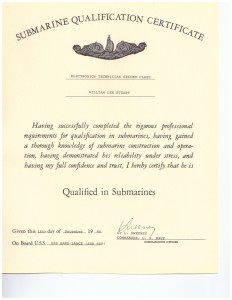
I don’t recall how long it took to qualify all of those watches, but I do know that I qualified submarines in December 1986 while I was on the Med Run. Here is my Submarine Qualification Certificate.

Reactor Critical WLS Sub Qual Certificate
Submarine Qualification Certificate

Fun times:

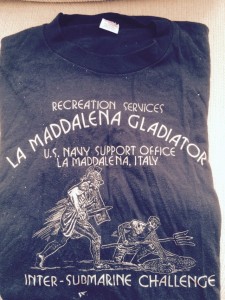
We did get to see and do some interesting things on the Med Run. We spent a fair amount of time in La Maddalena, Italy (a little island off the tip of Sardinia), where we participated in the Submarine Gladiator games. Despite its age and condition, I still have my t-shirt from those games!

Submarine Gladiator Games Shirt

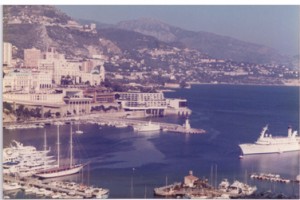
Luckily, I got a chance to visit Rome, Italy. I visited the Vatican, the Pantheon, Circus Maximus, the Coliseum, and many other amazing sites. We pulled into Toulon, France, where I got to play Shore Patrol for a night. I was paired with a sailor from the USS Savannah (AOR-4) and the things we saw and the people we had to escort back to the ships… let’s just say it was an interesting night! Those stories, though, are for another time! After my night of shore patrol, I hopped a train to Monaco and spent the weekend in Monte Carlo. Monte Carlo is an amazing place. The first picture is the harbor and the second is the palace where Prince Rainier and Princess Grace lived. Bear in mind that the pictures were taken in 1986, so things may have changed! We gambled at the Loews Casino and had a ball!

Monaco Harbor
Monaco Harbor (Fontvieille Harbor)
Palace at Monaco
Palace at Monaco (Palais Princier de Monaco)

Submarine life:

Of course, submarine life isn’t all just fun and games and visiting interesting ports. There is the day-to-day operational stuff, both at sea and in port, maintenance, training, and the stress of knowing that the hungry sea was lurking just outside the hull ready to crumple the boat like a beer can. In my 3 and a half years on Sandlance, I only recall one actual fight, so it’s a testament to the mindset of the submariners that they can handle the stress without cracking.

Many people ask me what the sleeping arrangements were like. Well, to say they were cramped would be an understatement. More like sleeping in stacked coffins than anything else. And what about food? When I tell people that we had to load food for months, that we stacked cans on the deck to the level of the first rack, and that we had a cook that tried to make pancakes from mayonnaise (because we had run out of fresh eggs), they just shake their heads in disbelief. And, when you mention the Sony Betamax entertainment system, most have no idea what I am even talking about!

One of the coolest (both literally and figuratively) places Sandlance went was under the Arctic ice cap. While we didn’t get to break through the ice and surface, I still got my Bluenose. We also visited the US Virgin Islands, the Bahamas, Puerto Rico (I missed that cruise), and Halifax, Nova Scotia.

Finally, though, Sandlance was due to head to overhaul in Portsmouth, NH. We left the warm climate of Charleston, SC and arrived at Portsmouth Naval Shipyard in Kittery, Maine in mid-1988. Interestingly, USS Sandlance was launched at Portsmouth in 1969.

Reactor Critical Sandlance launch
USS Sandlance (SSN 660) Launch 1969

Leaving Sandlance:

For me, this was the beginning of the end of my time on the boat. A short year and a couple of months later, I left the only submarine I ever served on and went to recruiting duty in Americus, GA. A future post about my time as a recruiter will be the last post of this series as I wrap up my Navy career.

I could spend much more time telling you about submarines and some of the things that happened underway. Many of them are funny, some are tense, and others show the perils of submarine duty. I will say that to this day, I miss the people, but don’t miss the boat so much! However, the experiences I had, and the people I met, helped me in my post-Navy career in ways I cannot even begin to explain. One of the characters in my books, The Gemstone Chronicles, uses knowledge gained from his days in the Navy to help out with the quest to find the stolen gemstones. That character was loosely based on me!

Are you a former Sandlance crew member, or a former or current submarine sailor, leave me a comment and tell me some of your experiences. As always, shares and feedback and greatly appreciated!

Connect with me:

Connect with me on social media on Twitter, Facebook, and Goodreads, or email me at bill@williamlstuart.com. To make sure you don’t miss a post, subscribe to the blog!

Filed Under: Submarines

Georgia Gold Mines -There’s Gold in Them There Hills!

September 29, 2014 by Bill Stuart 5 Comments

The California Gold Rush and the legendary Miner 49ers. We all learned about that gold rush in school. But, did you know that before gold was found in California, there was a gold rush in North Georgia? It’s true! There were many Georgia gold mines! Gold was discovered around Dahlonega in 1828, twenty years before gold was found at Sutter’s Mill.

Georgia Gold Mines Dahlonega Mint
Dahlonega Mint

At the height the of the gold rush, there were over 500 gold mines operating in 37 counties in North Georgia. Boom towns sprang up, miners streamed into the state, and many people found riches. And gold flowed out of the mines – so much so that a mint was opened 1838 in Dahlonega to process the gold into coins. Wikipedia says it’s estimated that from 1828 through the mid-2oth century (when commercial gold mining in Georgia stopped) 870,000 troy ounces of gold were mined. At today’s price of $1218/ounce, that is over $1 billion!!

The Gold Lottery of 1832:

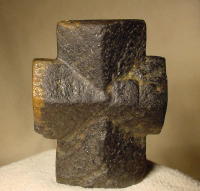
In 1832, the state of Georgia held a Gold lottery, selling 40 acre lots across North Georgia – land that belonged to the Cherokee. Despite protests from the Cherokee, the lottery winners swarmed into the lands and settled. The Cherokee were soon to be forcibly relocated along the infamous Trial of Tears. In The Gemstone Chronicles Book One: The Carnelian, Aidan finds some staurolite fairy crosses. One of the legends regarding the staurolite fairy crosses is that they are the result of the tears the Cherokee shed as they were forced from their home in the mountains.

Georgia Gold Mines Staurolite Fairy Cross
Staurolite Fairy Cross

I plan a future post of the Gold Lottery of 1832 and the Trail of Tears, so I won’t go deeper into that subject here.

Notable Figures in the Georgia Gold Rush:

There were some notable figures with ties to the Georgia Gold Rush. John C. Calhoun, Senator and the 7th Vice President of the United States, owned the Calhoun Mine. The Calhoun Mine produced a lot of gold during its time, as did the Loud Mine and the Consolidated Mine. The Calhoun Mine was managed for a time by Thomas Clemson, the founder of Clemson University.

Much of the gold found during the beginning of the gold rush was placer gold. Placer gold is gold that eroded away from the vein and deposited in stream beds, at the mouths of rivers, and other such places. Gravity wins with gold, as it is about 19 times heavier than water, so it won’t travel far from the source. By some estimates, gold will only travel about 1500 feet from the source. After the easily found gold was exhausted, miners invaded the creeks, streams, and rivers to dig into the beds and pan for gold. Below is a gold nugget found in the Dahlonega area.

Georgia Gold Mines Gold Nuggest
Dahlonega gold nugget

According to the Consolidated Gold Mine website, in 1845, John Hand developed a hydraulic mining method to dislodge material from the hillsides. This method meant that water cannons would point at a hillside and blast away the mountain and send the mud and rocks down the hillside and into sluices positioned below. Another method was to find the gold-bearing quartz (quartz is plentiful in Georgia), run the quartz through a stamp mill, crush the rock, and extract the gold. If you are lucky enough to be able to prospect on some of the lands around Dahlonega, you can still find tailing piles from the hydraulic mining days, and yes, there is still gold in them!

The California Gold Rush:

The gold rush in Georgia really died out when gold was discovered in California. With the difficulties of extracting the gold from the mountains, miners moved west and left the Georgia mountains. Wikipedia tells us the assayer at the Dahlonega Mint told the miners that there were still millions in the mountains, but he couldn’t persuade the miners to stay.

However, gold mining in Georgia wasn’t done. As mentioned above, commercial mining continued until the mid-20th century. The Consolidated Mine operated from 1895 until 1906 when the company failed. Whatever the reason it failed, it appears that it wasn’t due to a lack of gold! Below is a picture of the Glory Hole from the Consolidated Gold Mine.  The hole is shown looking upward. Imagine finding that much gold!

Consolidated Gold Mine Glory Hole

There is still gold in the Georgia mountains. It may be hard to come by, but the search is half the fun. I have a small sluice box that I use when I go gemstone hunting. I haven’t found any gold yet, but I have found where it wasn’t! Like Beebop’s character in The Gemstone Chronicles, though, I will keep looking because you never know! I might just start the next Georgia Gold Rush!

Are there gold mines where you live? Have you prospected? Just in case you might want to, here is a link to a site that gives links to prospecting clubs by state: http://www.goldminershq.com/clubs/gold1.htm.

Do you prospect? If so,leave me a comment with your search results. I want to hear about your adventures!

If you like this post, please feel free to comment and share. Feedback is always welcome!!

Happy prospecting!

Connect with me:

Find me on social media and let’s connect! I’m on Twitter, Facebook, and Goodreads. Stop by and say hi!

Filed Under: North Georgia Mountains

Reactor Start Up (or Becoming a Navy Nuke)!!!

September 12, 2014 by Bill Stuart 52 Comments

Reactor

Commence reactor start up! The statement itself conjures up many memories for me, and can be a metaphor for the start of my Navy career. As a refresher (for those who don’t know), I spent ten years in the Navy as an electronics technician, nuclear trained reactor operator, and finally, a recruiter. In the Navy, there are three different enlisted nuclear rates – Machinist Mate (MM) that includes the Engineering Laboratory Technician (ELT), Electrician Mate (EM), and Electronics Technician (ET) home of the Reactor Operators. Now, I have to admit that whoever decided to make me an ET knew that my mechanical skills were…um…less than optimal for the other rates.

My career started in Great Lakes, Illinois at Recruit Training Command (boot camp). After boot camp in Great Mistakes er..Lakes, I headed off to Electronics Technician “A” School (during which I spent a grueling winter on the shores of Lake Michigan). After graduating, it was off to Orlando for Nuclear Power School (aka Uncle Hyman’s School for Misguided Children – nicknamed for the father of Naval Nuclear Power, Admiral Hyman Rickover). After warm sunny Orlando, it was off to Idaho (yes, a Navy school in Idaho) for prototype training, where I actually ran an operating nuclear power plant.

This is me with my Recruit Training Command Company. We were the Color Company of our graduating class (I’m in the lower right hand corner of the picture).

Company 158 Reactor Start Up
Company 158 Great Lakes Naval Training Center

One very cool thing about graduation was the keynote speaker. Admiral Grace Hopper – one of the pioneers of modern computers – was our graduation dignitary! The lovely and adorable Lana often uses this quote attributed to Admiral Hopper: “A ship in port is safe, but that’s not ships are built for.” Powerful words from an amazing woman!

As I mentioned earlier, I was lucky enough to spend a winter in Great Lakes attending ET “A” School. We learned to troubleshoot electronics gear and managed to survive the snow and ice of a northern Illinois winter. For someone who had lived in South Georgia for a long time, it was cold and miserable!! Below is my ET “A” school graduating class.

Reactor Start Up ET A School
ET “A” School

Sunny Orlando was the next stop on my Navy journey. Before Nuke School started, I was a Master At Arms at the Transient Personnel Detachment. What does all that mean? We were the shore patrol for the barracks for the Nuke School drops that were headed for the fleet, or, depending on the reason for the drop, perhaps out of the Navy. Too many stories to tell about that temporary duty station, but it was certainly an eye-opening experience! The fun had to come to an end, though, and it was off to Nuclear Power School.

Nuclear Power School Orlando, FL:

How can one describe Nuclear Power School? To say it was difficult would be a massive understatement. Basically, you crammed mathematics, nuclear physics, electrical power and generating equipment, nuclear reactor technology, thermodynamics, chemistry, materials science, metallurgy, health physics, reactor principles, and reactor ethics into 6 months. Taught at the college level, our classes ran from 8:00 – 4:30 pm, and students still had to stand watches. Oh, and you had to do homework at school since the training materials were classified and couldn’t leave the building.

Grades and studying:

That was 40 classroom hours per week. I was on suggested 20 study hours while I was in Orlando, so I had at least 60 hours per week in the classroom. Others had mandatory study of 40 hours, so 80 hours per week in the classroom. Add to that the pressure to excel or even to keep up, and it’s understandable why the attrition rate was and still is, by some accounts, > 70%! We had to maintain at least a 2.5 GPA on a 4.0 scale, and the popular view was 2.8 and skate! Somehow, I made it through with a decent GPA and it was off to Idaho! Here is the 8407 Class picture. Interestingly enough, my future Executive Officer (XO) on the Sandlance is in this picture.

Reactor Start Up NNPS Class 8407
Class 8407 Naval Nuclear Power School

Prototype in Idaho Falls:

I arrived in Idaho Falls, Idaho on February 14, 1985 to three feet of snow. After Great Lakes, though, I was ready for the snow. What I wasn’t ready for was prototype. Yes, we still had a lot of theory to learn, but now we were actually running a nuclear reactor.

We worked 12 hours days on a rotating shift, rode a bus for an hour in each direction (which turned our 12 hour days into 14 hour days), and generally lived at the site. Prototype training lasted 6 months, just like Nuclear Power School, and was just as intense – though in a different way. A lot of students who did well in the theoretical world of Nuke school struggled putting theory into practice.

Again, with a lot of help from my sea dad, my advisers, and my classmates, I made it through  prototype. I actually performed a reactor start up for the first time at prototype. Idaho Falls was its own adventure, but that is a story for another time! I was the second person in my class to qualify Reactor Operator. My orders sent me to the USS Sandlance (SSN660) home ported in Charleston, SC.

Reactor Startup USS Sandlance Charleston
USS Sandlance (SSN660)

There you have an outline of the beginning of my time in the US Navy. In a future post, I will talk about my time aboard USS Sandlance (SSN660) a Sturgeon Class fast attack submarine. If I hadn’t had these experiences, I couldn’t have used them in my fantasy adventure series The Gemstone Chronicles!

I love to connect with other submariners and current and former Navy nukes. If you are one, or know one, please leave me a comment and let me know about your experiences. As always, shares and feedback are always welcome!

Connect with me:

You can also connect with me on social media. Find me on Twitter, Facebook, and Goodreads,, or send me an email at bill@williamlstuart.com. And, so you don’t miss a post, subscribe to the blog!
Filed Under: Submarines

  • « Go to Previous Page
  • Page 1
  • Interim pages omitted …
  • Page 41
  • Page 42
  • Page 43
  • Page 44
  • Page 45
  • Interim pages omitted …
  • Page 63
  • Go to Next Page »

Footer

Follow Me on Social Media

  • Email
  • Facebook
  • Pinterest
  • Twitter

Follow Me on Goodreads!

Follow Me on Goodreads

Search this website

Site Policies

  • Privacy Policy
  • Terms of Use
  • Cookies Policy
  • Accessibility Statement

Copyright © 2026 Food and Fiction, LLC. All rights reserved.